One of the biggest dreams for Indian students today is to study abroad. Parents seek quality education, a safe environment, and a bright future for their children. Students want to gain practical knowledge, international exposure, internships, and job opportunities. France offers all of this, and thousands of Indian students choose to study there every year.
This blog focuses on studying in France for Indian students. It has simple, straightforward, and to-the-point information about everything you need to know about studying in France. You will get information about courses, fees, scholarships, visa requirements, living expenses, and post-study job options. It has been crafted keeping Indian students and parents in mind so that you can make informed decisions and go with confidence. If you want to study in France in 2026, this blog is your ultimate guide. Take your time, follow each step carefully, and begin your journey towards a successful global career.
Why Choose France?
This section highlights the key advantages, career benefits, and practical reasons for Indian students choosing France, helping parents and students decide with confidence and clarity now.
France offers strong universities and renowned Grandes Écoles, combining practical learning with internships. Many programs run in English. This makes it easy for Indian students who do not yet speak French. The country is strong in engineering, business, design, hospitality, and research. French degrees are respected worldwide. Indian families value both the quality and affordability of education, and Campus France supports students with the process. TBS Education can help shortlist programs and check costs.
Main benefits at a glance
- Global-ranked universities and quality teaching.
- English-taught programs plus options to learn French.
- Good industry ties and internship chances.
- Affordable public university fees with value for money.
- Diverse fields: tech, fashion, hospitality, and science.
- Safe student towns and support services.
- Large international community, including Indian students.
- Travel around Europe easily on breaks.
- Student discounts are available on transportation.
- Post-study work is available in various fields.
Higher education in France can provide you with a strong degree, hands-on skills, and increased employment opportunities. It is a low-cost study abroad plan for many.
Courses, Fees And Living Costs
Here we cover courses, realistic fees, and monthly budgets. Read these numbers to plan tuition and living costs clearly before applying to any French university.
When planning to study in France, Indian students should pick a course that fits their career. Public universities often cost less. Grandes écoles and private schools cost more but have good placement networks. Below are the common study routes and approximate fee ranges.
Best courses in France for Indian students
- Engineering and Computer Science — strong labs and jobs.
- Business, Management, and MBA — grandes écoles have global links.
- Data Science, AI, and Analytics — rising demand in Europe.
- Fashion, Design, and Luxury Management — Paris advantage.
- Hospitality and Culinary Arts — world leaders in training.
- Life Sciences and Pharma — research opportunities and labs.
- Short professional diplomas and exchange programs for practical skills.
Study in France after 12th: options
- Direct Bachelor’s (Licence) programs for students who have completed Class 12.
- Foundation or pathway courses to build language and subject skills.
- Design, fashion, and hospitality schools take 12th-grade applicants.
- Some engineering schools require entrance exams or preparatory courses.
Study in France fees: realistic ranges
- Public universities: tuition is often low compared to that in many countries. Fees vary by program.
- Bachelor’s at public universities: typically modest registration fees.
- Master’s at public universities: slightly higher but still affordable.
- Grandes Écoles and private programs: €5,000–€30,000 per year, depending on the institution and course.
- Always look at the official university page for the exact fee.
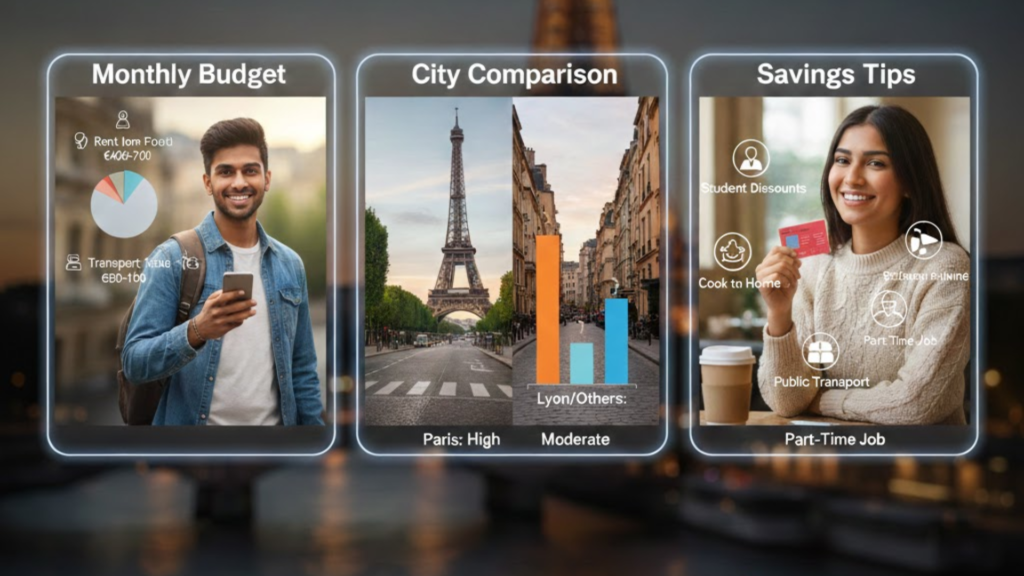
Monthly Living costs in France for Indian students
- Small cities: €600–€800 per month.
- Regional cities like Lyon and Toulouse: between €700–€1,000 per month.
- Paris: €1,000 or more per month, primarily due to higher rent
- Housing facilities like student residences, flats, and CROUS housing help reduce the living expenses.
- Plan your budget for food, transportation, phone, health insurance, and minor miscellaneous expenses.
Money-saving tips
- Public universities are preferred where there are budget limitations.
- Apply early for CROUS or university housing applications.
- Sharing of flats or student houses to lower the rent.
- Use student transport passes and discounts.
- Part-time work to balance the living expenses by working within the legal limits.
Visa, Scholarship, and Application Steps
These are step-by-step tips for visas, scholarships, and applications. This section aims to help you prepare your file, to carry out the Campus France procedure, and to avoid the most common mistakes during the visa application as early as possible.
When you are applying, get things clear and put things on track. Most students opt for the Campus France (Études en France) route. The long-stay student visa (VLS-TS) is required. You need to have your documents in order and proof of funds. Check out the checklist below.
France student visa for Indian students — step by step
- Secure an invitation from a recognised French university or school.
- Sign up to Campus France (Études en France) if that’s a requirement in your program.
- Gather Documents: passport, photos, transcripts, SOP, CV, and proof of funds.
- Sign up on the France-Visas site, and pay the fees.
- Make a VFS Global booking in India to register the biometrics and submit the documents.
- Go to the appointment, and wait until the decision on the visa. Check VLS-TS validation on arrival.
Study abroad in France requirements — document checklist
- A valid passport with a minimum validity of six months.
- Formal letter of acceptance or provisional offer.
- University documents and diplomas.
- Evidence of financial ability or a college letter of scholarship.
- Valid language test scores(IELTS/TOEFL on English courses; DELF/DALF on French courses where necessary).
- CV and Statement of Purpose (SOP).
- Evidence of accommodation (reservation or registration at university accommodation).
- Biometric and health insurance (if needed).
- Receipts for visa fee payment and appointment.
Campus France process and help
- Campus France assists in the verification of credentials and in the direction of interviews.
- They have study fairs and counselling in India.
- Campus France approval is required for many French universities.
- Get their advice on applying and visa preparation.
Visa success tips
- Hand in the entire set of documents. Missing items cause delays.
- Present definite funds or a scholarship. Bank proofs must be clean.
- Write a short and candid SOP of how you plan to study.
- Book a VFS appointment early enough, particularly during peak months.
- A copy of all documents should be kept, and official portals should be used.
Work, Study, And Future Jobs: Life in France
This quick section covers work options, internships, and post-study possibilities so Indian students can plan career steps and daily life in France.
France allows part-time work for students. Internships are often built into degrees. After graduation, you may apply for a job search or a work permit. Basic French improves daily life and job chances.
Work & internships
- Students can work up to the legally permitted hours to support living costs.
- Internships are common and help build experience.
- Many tech and engineering students get internships in the industry.
- Hospitality and fashion students often intern with top brands.
Post-study options
- Job search permits often let recent graduates stay and look for work.
- Companies hire international talent in IT, research, hospitality, and design.
- Consider short-term contracts, apprenticeships, or startups.
Daily life tips
- Open a local bank account after arrival.
- Get a local SIM and student transport card.
- Register for French student social security.
- Learn basic French phrases for daily tasks.
What Are the Common Mistakes and How to Avoid Them?
This brief remark reminds students of the mistakes in application, visa, and financial planning, which may lead to delays or refusals. Some of the pitfalls to avoid with your study abroad plans in France include:
- Do not miss university and scholarship deadlines.
- Do not file an unfinished visa application. Double-check everything.
- Never pay agents before verification, even when they are not known or are unofficial.
- Accommodation planning should not be overlooked, particularly in Paris.
- Remember to take health insurance and emergency contacts.
Conclusion
Studying abroad is always a big step in anyone’s life, especially in India. This blog further explains how Indian students can study in France. Get prepared, compare prices, seek scholarships, and complete the visa process. France has good courses, excellent research and numerous career paths. Start early and take consistent steps toward your academic goals each week.
FAQs
1) How much does it cost to study in France for Indian students?
2) Is France good for Indian students?
3) Is an MBA in France for Indian students worth it?
4) What are the benefits of an MSc in France for Indian students?
5) Can Indian students study in France without IELTS?
6) What is the proper procedure to study in France?
– Compile documents
– Register on Campus France
– Apply to universities
– Attend interview (if necessary)
– Apply for a visa
– Arrange accommodation
– Travel to the destination
7) Best colleges in France for Indian students?
8) Which is better, France or the UK, for Indian students?
9) What is student life like in France?
10) What are the options for a Scholarship to study in France?
Final checklist: Ready to Apply
A simple checklist to help you finish applications, prepare for a visa, and move smoothly to France.
- Shortlist 3–5 programs and check the exact fees.
- Confirm the study in France requirements for each program.
- Apply for scholarships such as Eiffel and university grants early.
- Register with Campus France if needed.
- Book a VFS appointment and keep all documents carefully.
- Arrange provisional housing and plan arrival transport.
- Learn basic French and local customs.
If you need help with course shortlisting, SOPs, or visa paperwork, TBS (https://tbseducation.in/contact-us/) can assist Indian students step-by-step.